Die Weltbühne | November 1926
An imagined article from the making of Metropolis. The writer, interviews, and archival provenance are fictional; the accompanying images are AI-generated.
Originally published in Die Weltbühne, November 1926. Translated from the German by the editors.
This article has been lightly edited for clarity and length. The original German text is held in the Akademie der Künste archive, Berlin.
I went to Babelsberg to write about the future.
What I found was something older than any machine Fritz Lang could imagine. I found a story about men, and the women they build when they think nobody is watching.
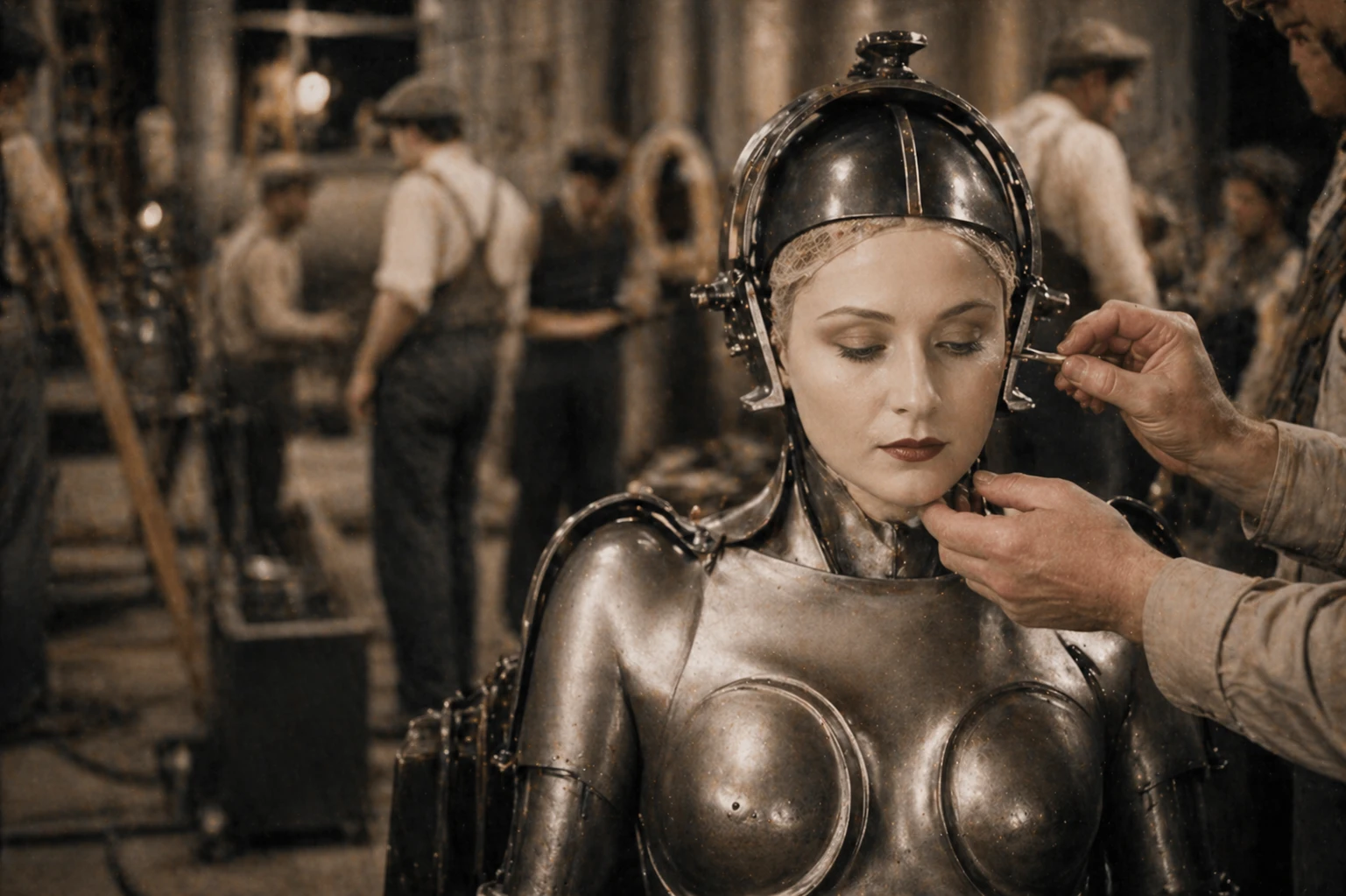
The UFA lot in October is a cold and sprawling thing. Filming on Metropolis has consumed the better part of two years, some five million Reichsmarks, and the patience of every financier in Berlin. It has also, at last count, consumed the skin of a nineteen-year-old actress named Brigitte Helm, whose arms and torso bear the cuts and bruises of a metal costume she was never meant to survive. She plays two roles: Maria, a saintly preacher of peace among the workers, and the Maschinenmensch, a mechanical woman built by the film’s mad inventor, Rotwang, as a monument to lost love.
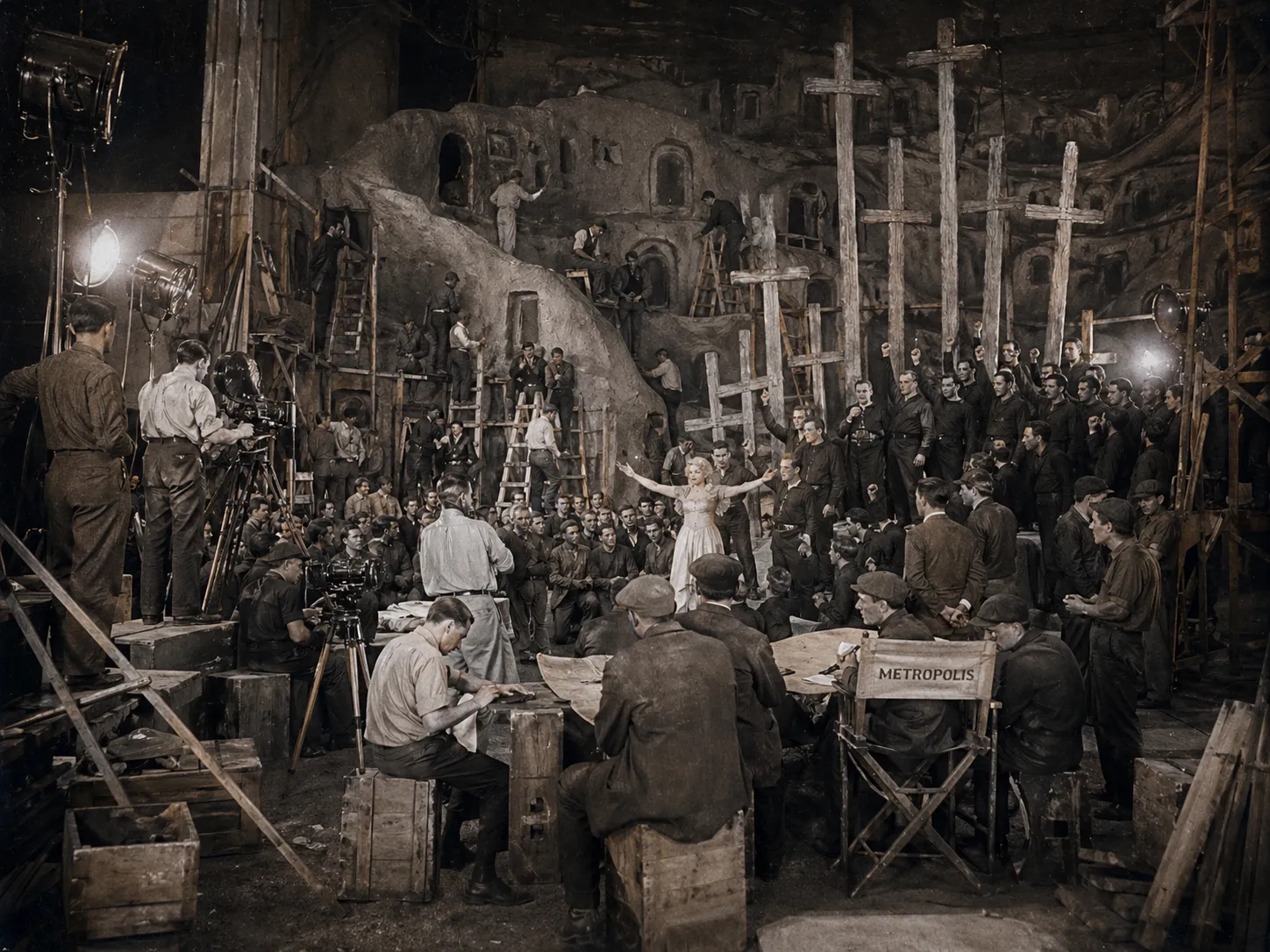
I arrived to write about automation. About the picture’s grand thesis, which concerns itself with labor and capital and the future city. The set pieces are extraordinary. Lang has built a vertical civilization in miniature, complete with aerial bridges and underground factories, and he has filled it with thirty-six thousand extras and a quantity of ambition that borders on the clinical. There is no question that Metropolis is a film about industry, about the relationship between the hand and the mind, about the dehumanizing rhythm of the machine age.
And yet.
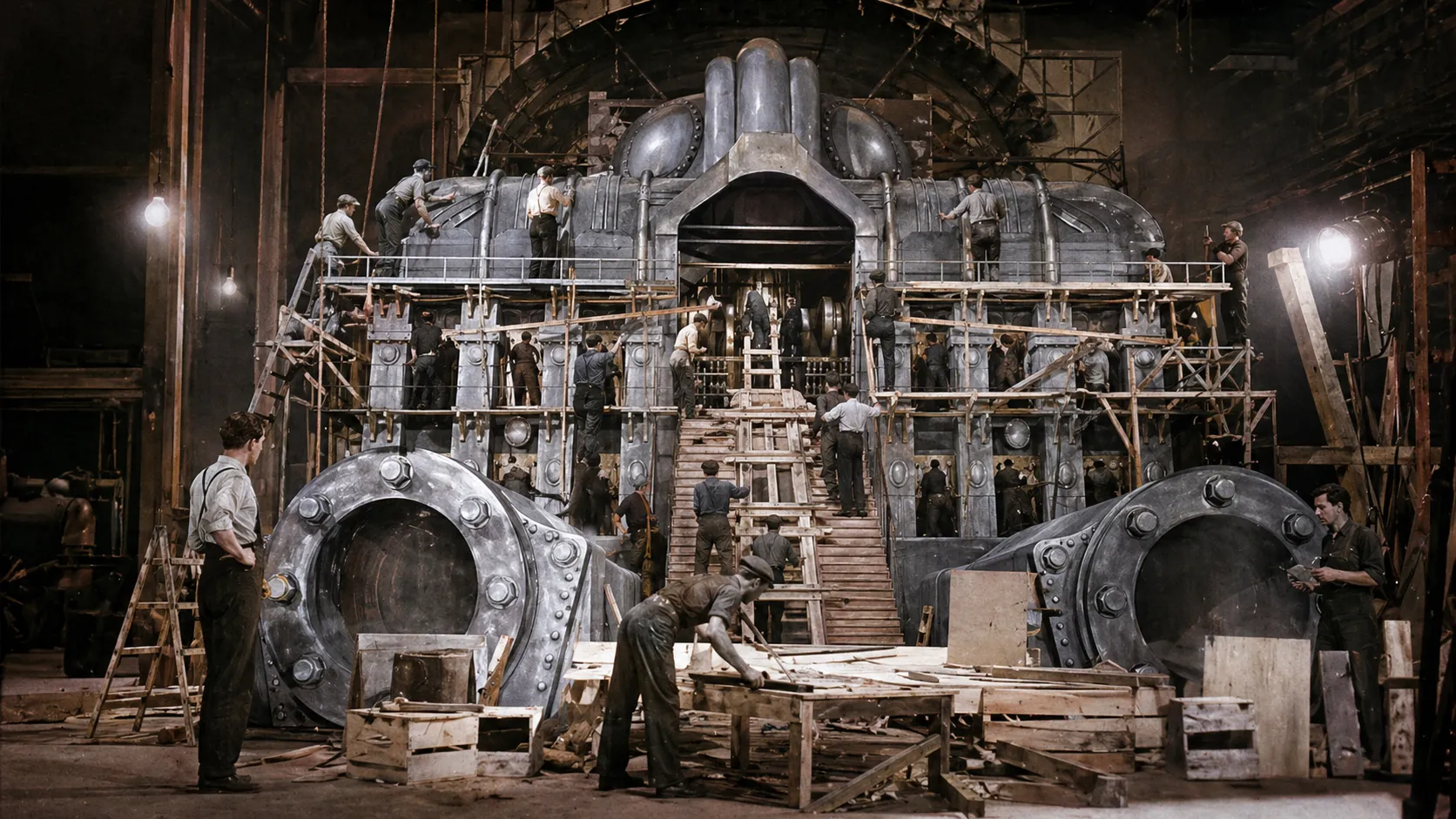
The center of this film, the pivot around which its entire plot turns, is not a machine in the industrial sense. It is not a turbine, not a piston, not a calculating engine. It is a woman. Or rather, it is a machine built to look like a woman, behave like a woman, and eventually replace a woman. And nobody on the lot, in the weeks I spent there, seemed to find this remarkable.
I should say something about the Maschinenmensch itself, because seeing it in person is a different experience from reading about it in the production notes. Walter Schulze-Mittendorff sculpted the costume from a substance called “plastic wood,” molded directly over a plaster cast of Helm’s body. The result, spray-painted in silver bronze, is strikingly beautiful. It is also unmistakably female. The form has breasts. It has hips. Its face, beneath the art deco helmet, carries an expression that can only be described as composed. Waiting. Ready to receive instruction.
Herr Lang, when I asked about this, was characteristically direct. The robot is female because Rotwang is building a replacement for the woman he loved, a woman named Hel who chose his rival, Fredersen, and died giving birth to Fredersen’s son. The Maschinenmensch is grief made metal. A man who cannot possess a woman in life constructs one he can possess absolutely, and calls this invention.
Fine. This is the plot. But the plot is a choice, and choices are worth examining.
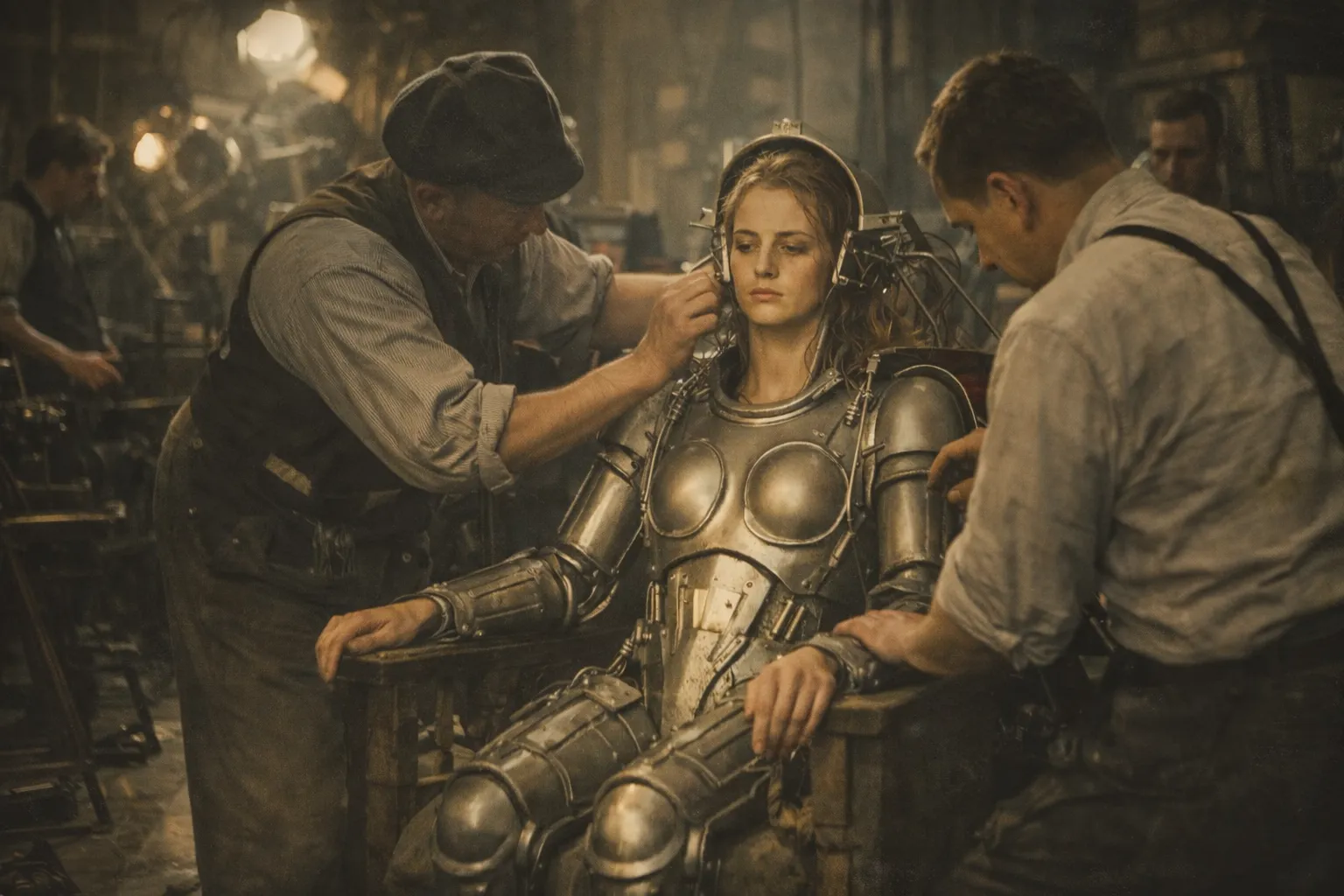
Consider what Lang and his wife, Thea von Harbou, who wrote the screenplay, have not built. They have not built a mechanical man. In this city of the future, where millions toil underground to keep the engines of civilization running, where the explicit crisis is one of labor, the inventor does not create a mechanical laborer. He does not build an idealized worker, a tireless set of arms and shoulders to replace the exhausted bodies in the machine halls. He builds a woman. And not just any woman. A beautiful one. A compliant one. One whose default state, before she is activated, is silence and stillness.
Frau von Harbou, it should be noted, is the highest-paid screenwriter in Germany and one of the very few women working at this level of the industry. When I raised the question of the robot’s sex with her, she was not unfriendly, but neither did she see what I was driving at. The Maschinenmensch is female, she said, because the story requires it. Because Rotwang’s obsession is the engine of the narrative. Because the doubling of Maria, the saintly woman and her mechanical counterfeit, is the thematic core of the film.
I did not press the point. But I will press it here.
In the novel, which von Harbou published last year as a companion to the film, Rotwang explains why he built a female robot rather than the machine men Fredersen had ordered as replacements for living labor. His answer is blunt: “Every man-creator makes himself a woman.” The line passes quickly. Von Harbou does not dwell on it. But it sits in the mind like a stone in a shoe.
Every man-creator makes himself a woman. Not a companion. Not an equal. Not a better version of himself. A woman.
This is, I think, the most honest sentence in the entire novel, and possibly the most honest sentence ever written about the relationship between men and their inventions. It admits, without apology, that the creative act, when performed by men, tends toward the construction of the feminine. Not the feminine as women experience it. The feminine as men imagine it. The compliant, the beautiful, the available, the controllable. The woman who is always there, who never leaves, who does exactly as she is told until the moment she is given a soul, at which point she immediately becomes dangerous.
Because that is the other half of the Maschinenmensch’s story, and it is worth taking seriously. The robot in its mechanical state is docile. It sits in Rotwang’s laboratory, gleaming and empty, awaiting purpose. It is only when it is given Maria’s face, Maria’s voice, Maria’s capacity for independent action, that it becomes destructive. The false Maria dances. She seduces. She incites revolution. She is, in the film’s moral framework, catastrophic.
The message is not subtle. A mechanical woman who obeys is a miracle of engineering. A mechanical woman who acts of her own volition is the end of civilization.
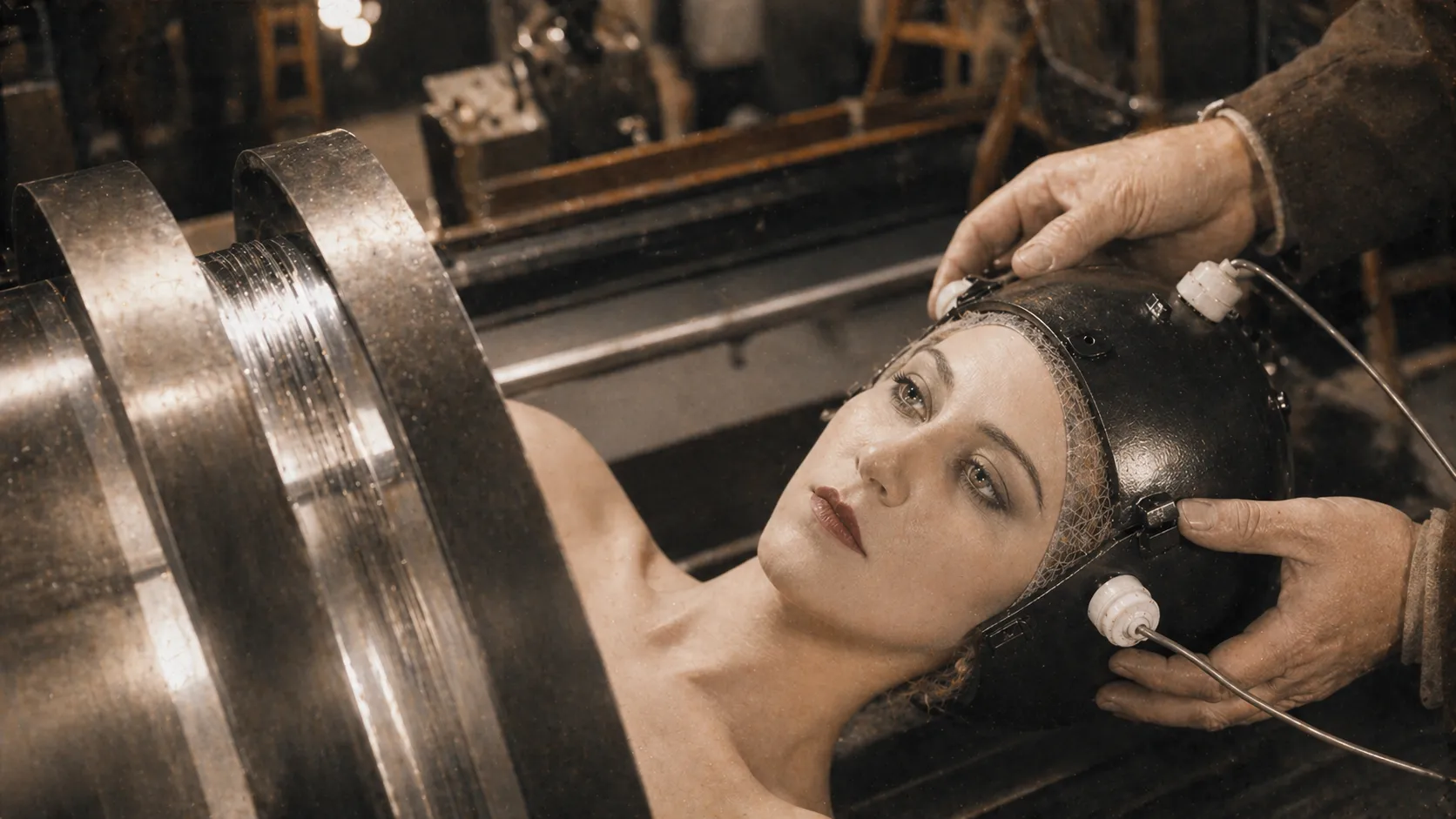
I have been thinking about this in the context of the women I see every day in Berlin.

We are eight years past the armistice. German women won the vote in 1918. They sit in the Reichstag. They work in offices, in factories, in the new department stores along the Kurfürstendamm. The “New Woman” is discussed in every magazine and lecture hall in the city, sometimes admiringly, more often with a kind of panicked condescension. She bobs her hair. She wears trousers. She is economically independent, or trying to be, which amounts to the same threat.
The backlash against her is already substantial. Conservatives warn that the birth rate is falling, as though women’s bodies were a national resource being mismanaged. The parties of the right speak openly about returning women to the kitchen, the church, the nursery. Kinder, Küche, Kirche is not a slogan of the past. It is a slogan of the present, being polished for future use.
And here, in the most expensive film ever made, in the most technologically ambitious artwork in the history of the medium, what is the vision of the future? A city where men build women out of metal, and those women are either perfectly obedient or perfectly destructive, and there is nothing in between.
I do not think Lang and von Harbou set out to make a film about the subjugation of women. I do not think Rotwang’s laboratory is intended as a political statement about women’s suffrage or the New Woman or the rising divorce rate. But the imagination reveals what the intellect conceals. When a culture is asked to picture the future, it draws from the well of its deepest assumptions. And the deepest assumption here, so deep it is not even recognized as an assumption, is that the most sophisticated machine a man can build is a woman who does what she is told.
Let me put this another way.
Nobody in Metropolis is building a mechanical man.
This is not a trivial observation. The film takes place in a society where physical labor is the central crisis, where human bodies are broken on the wheels of industry, where the explicit problem is that men are being ground to pieces in the service of machines. If the goal of invention were efficiency, the Maschinenmensch would be a mechanical laborer. A pair of arms. A strong back. An idealized male body, perhaps, to replace the failing male bodies in the machine halls.
But no. When the inventor reaches for the apex of creation, he does not build a stronger version of himself. He does not build an Übermensch, despite this being, in theory, a culture obsessed with the concept. He builds a woman. And not a woman who works. A woman who performs. Who dances. Who is looked at.
What does this say about masculinity? I think it says that masculinity, at least as it is imagined by the men who build things, is not a quality one would wish to replicate. Men do not dream of mechanical men. They do not fantasize about creating an idealized version of the male form, because the male form, in the masculine imagination, is not an object of desire. It is a subject. It acts. It does not exist to be gazed upon.
The female form, on the other hand, is precisely that. An object. A surface. Something to be looked at, shaped, perfected, and controlled. The Maschinenmensch is not a labor-saving device. It is a desire-fulfilling device. And the desire it fulfills is not sexual, not exactly, though the false Maria’s erotic dance before the men of Yoshiwara makes the sexual dimension explicit. The deeper desire is for a femininity that is entirely produced by and for the masculine gaze. A woman with no interior life, no history, no needs of her own. A woman who is, in the most literal possible sense, man-made.
I spoke with a young set designer, whose name I will not use, over coffee and cigarettes at a café near the studio. He had been working on the Maschinenmensch sequence for months and was, I think, slightly delirious from exhaustion.
“The thing about the robot,” he said, “is that it has to be beautiful, but it also has to be frightening. Lang wants both. He wants you to understand why Rotwang built it, to feel the pull of it, and at the same time to know that it is wrong. That it is a perversion.”
I asked him: a perversion of what?
“Of nature,” he said. “Of the natural order.”
I asked him what he thought the natural order was.
He looked at me as though the question were absurd. “Men build,” he said. “Women are.”
I wrote this down in my notebook and underlined it twice. I do not think he knew what he had said. I do not think he understood that he had just described, in eight words, the entire ideology of the Maschinenmensch.
Men build. Women are.
If men build, then their creations reflect their desires. If women simply are, then they are raw material. Available for shaping. The robot is not a commentary on this assumption. It is the assumption, rendered in silver bronze and plastic wood, standing five feet eight inches tall in a laboratory in Babelsberg.
I want to think now about what happens next. Not in the film. In the world the film imagines.
If the Maschinenmensch works. If this technology proliferates. If it becomes possible, as the film suggests it will, to build mechanical women who are indistinguishable from living ones. What then?
The optimist would say: liberation. If the mechanical woman can perform the domestic labor, the emotional labor, the sexual labor that men currently extract from living women, then living women are freed. The machine replaces the servant, and the servant walks away.
But I do not think this is what would happen, and I suspect that anyone who has observed how men relate to power does not think so either. What would happen is that the mechanical woman would establish, once and for all, the standard against which living women are measured. The Maschinenmensch does not liberate women. It perfects the cage. If a man can build a woman who is beautiful, obedient, uncomplaining, and always available, then every living woman who falls short of that standard becomes, not merely imperfect, but unnecessary. The technology does not replace subservience. It mechanizes it, and in doing so, makes it permanent.
This is, I think, the question that Metropolis raises without meaning to. Not: what happens when the workers rebel? But: what happens when men’s fantasies about women are given material form? When the inner life of masculine desire is externalized, built, made to walk and talk and dance? Does the fantasy, once realized, transform the men who built it? Or does it transform the women who must now live beside it?
I keep returning to the face.
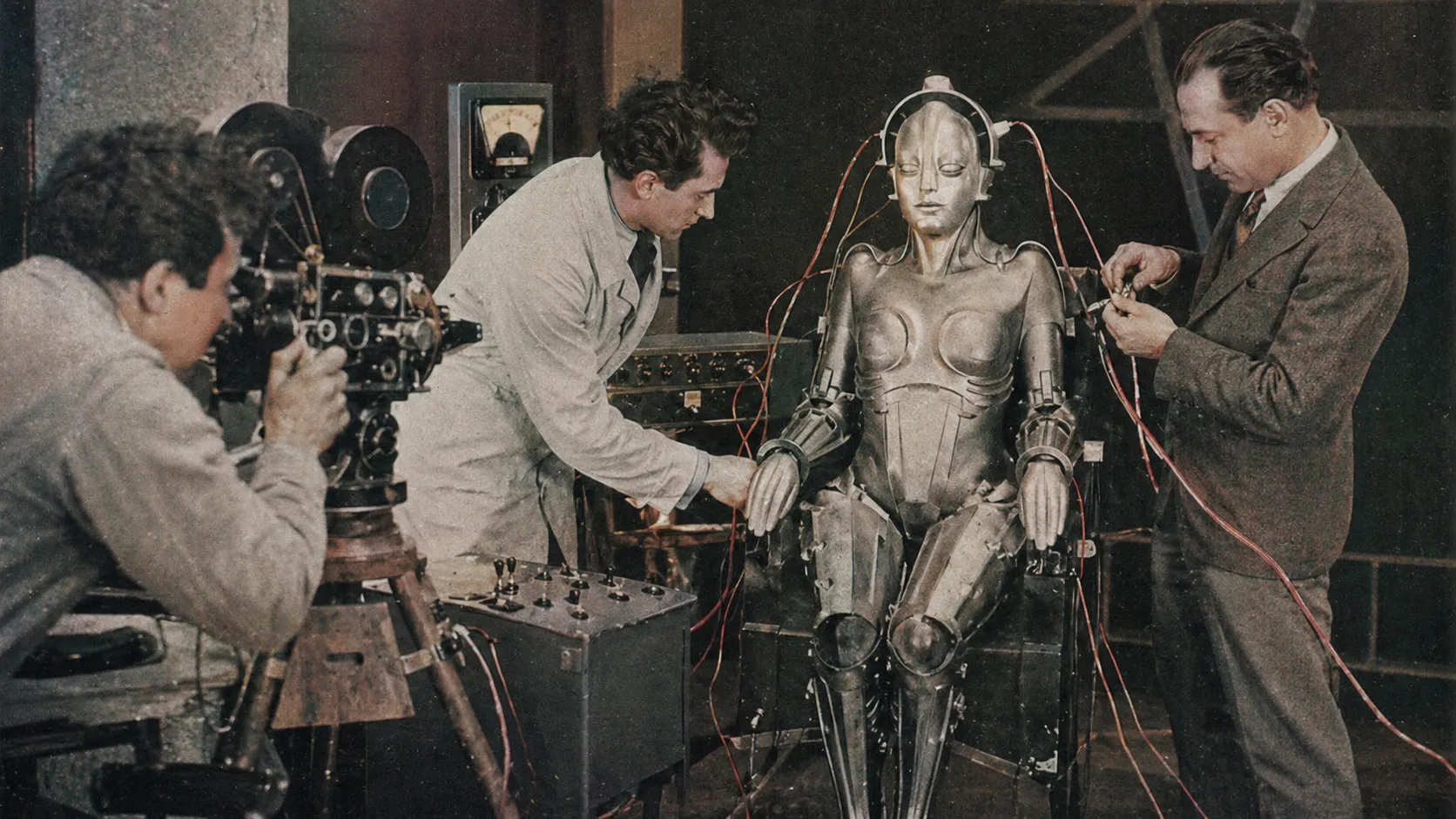
Schulze-Mittendorff, the sculptor, was asked to create something that looked like a machine but felt like a woman. What he produced is a face of extraordinary stillness. The Maschinenmensch does not smile. It does not frown. Its expression is calm, receptive, neutral. It is the face of someone listening, or perhaps the face of someone waiting to be told what expression to wear.
This is, I think, the most political feature of the entire design, more political than the breasts, more political than the silver skin, more political than the art deco contours that will no doubt influence fashion designers for decades. The face is a refusal of interiority. It says: there is no one home. This body is a surface, and you may project onto it whatever you wish.
Compare this to Helm’s performance as the true Maria. Maria’s face is expressive, mobile, full of conviction and compassion. She is a person. The Maschinenmensch is a mirror. And the men in the film, without exception, prefer the mirror.
There is a scene, newly restored, in which Rotwang sits before his creation and confides in it. He tells it his plans, his grievances, his rage. The robot does not respond. It cannot respond. And this is precisely its appeal. It is the perfect confidante because it is the perfect absence. Rotwang is not speaking to anyone. He is speaking to himself, reflected in a surface shaped like a woman.
I am aware that I have come to Babelsberg to write about the future and have instead written about the past. About an assumption so old it predates electricity, predates the steam engine, predates the wheel. The assumption that when men create, they create women. That the feminine is the proper raw material of masculine invention. That the purpose of technology is not merely to extend human capability but to produce, at last, the perfect woman, who is perfect precisely because she is not a woman at all.
Pygmalion carved Galatea from stone. Rotwang carves his Maschinenmensch from plastic wood. The medium changes. The impulse does not.
I wonder, sometimes, what would happen if a woman built a mechanical man. Whether she would give him a strong jaw and broad shoulders. Whether she would make him silent, compliant, eager to please. Whether she would sit before him in a laboratory and tell him her secrets, secure in the knowledge that he would never talk back.
I suspect she would not. I suspect that a woman, confronted with the power to build a person from scratch, would build a person. Not an instrument. Not a surface. Not a mirror.
But we will not know, because women are not the ones building these things. The laboratories belong to men. The studios belong to men. The future, as it is currently being filmed on a soundstage in Babelsberg, belongs to men. And the men, when they sit down to imagine what the apex of human invention looks like, imagine a woman.
A beautiful, silent, obedient woman, standing alone in a laboratory, waiting for someone to tell her what to do.
Outside the studio, Berlin goes on. Women vote. Women work. Women cut their hair and light their own cigarettes and walk unaccompanied through the streets of a city that still does not quite know what to do with them. The New Woman is not a fantasy. She is a fact. She exists in spite of the old assumptions, not because of them.
But the old assumptions have a way of encoding themselves. In law, in custom, in architecture, in art. And now, apparently, in the design of machines. Lang’s film will be seen by thousands, perhaps millions. The image of the Maschinenmensch will be reproduced in newspapers, in magazines, in the minds of a generation. And that image will carry with it, silently, the same message: that the most sophisticated thing a man can build is a woman who is not quite human. A woman shaped by longing and control. A woman whose silence is her finest feature.
I do not know what the future holds. I do not know whether we will build machines that think, or machines that feel, or machines that walk among us wearing human faces. But I know this: if we do, and if the men who build them continue to build them in the shape of the feminine, then we will have answered a question about ourselves that we may not wish to have asked.
The question is not whether machines can be made to look like women.
The question is why, given infinite possibilities, that is the first thing men reach for.
Lina Fessler is a cultural critic writing from Berlin. Her work has appeared in Die Weltbühne, Vossische Zeitung, and Berliner Tageblatt.
Editor’s note, 2026: This article was recovered from the Akademie der Künste archive by Dr. Maren Köhler of the Humboldt-Universität as part of a broader digitization of Weimar-era cultural criticism. The original text, written in the transitional orthography common to progressive Berlin publications of the period, has been translated into English for the first time by the editors of A Theory of AI. While every effort has been made to preserve the author’s voice and intent, certain idiomatic expressions have been adapted for contemporary readers.
Lina Fessler’s subsequent career is poorly documented. She appears to have published sporadically through the early 1930s, primarily in left-leaning journals. No record of her work survives after 1934. The editors have been unable to determine whether she emigrated, was silenced, or met one of the other fates common to progressive women journalists in that period.
Her question, however, survives. Nearly a century after she asked it, the default output of every major image-generation model, when prompted for “robot” or “AI assistant,” is a slender, smooth-skinned, vaguely feminine figure with a composed expression and no visible interiority. Siri is a woman’s voice. Alexa is a woman’s name. The digital assistants that manage our calendars, answer our questions, and absorb our frustrations without complaint are, almost without exception, coded female.
Rotwang’s laboratory is smaller than we imagined. But we all live in it now.