I. The Confession
The codebase was fifteen years old and over one million lines of accumulated decisions, compromises, best intentions, forgotten arguments, abandoned migrations, and fossilized hope. Teams had tried to modernize it, transform it, or break it apart year after year without success. Often they made it worse instead of better.
Over the years since AI had arrived, every attempt to use it had also failed. The system was too large, too tangled, too far outside the clean boundaries that make models look useful in demos. At best, the tools produced partial truths, fluent lies, and untrustworthy omissions. The context window would swallow a fraction of the codebase and lose the plot. Agents would optimistically find and grep their way through the codebase and hope to return something useful. Retrieval, summarization, and any other popular scaffolding produced output that sounded like understanding and demonstrably wasn’t.
But I had spent years working on this and other systems like it. I knew how to move through them. I knew which paths led somewhere real, which structures told you something true about the system, where the actual decisions were fossilized in the code and where there was only noise. I knew where the bodies were buried. It took time to learn, but myself and many developers before me had learned to master it. We hadn’t mapped the whole ocean, but we were explorers able to navigate its depths.
Intuition told me there was a method there, hard to document and explain perhaps, but not magic. That felt like an engineering problem. If I could teach another person to move through the system the way I did, why couldn’t I teach the model to do what I do?
That question became a tool that could not only map the codebase but operate over it in a way that was verifiably correct and profoundly powerful. It generated a decomposition and migration strategy that was not merely plausible but actionable: a concrete plan for how to safely and thoroughly disassemble a system that every previous attempt had failed to crack. It wasn’t a matter of producing the answer more quickly. It produced an answer that had never existed before. It did in hours what previously months of effort repeatedly failed to do.
This wasn’t a demo. It was a real unlock for a real company moving billions of dollars a year through a system that had resisted every previous attempt to change it. I had built an AI-enabled application that could do work that would have been, for all practical and economic purposes, nearly impossible before.
Through that process of building this tool and others over the past year, I’ve been all in on agents writing my code. Not vibe coding, but writing specs, making the architectural decisions, and leveraging AI to build it. The speed unlock for delivering both the code analysis tool and several other major initiatives (often at the same time) was unquestionable. It wasn’t always easy. I went through the change curve several times. Always though, when I would despair that AI was an illusion and couldn’t succeed, I would eventually find a new path that would enable the quality and results I needed.
Even so, I consider myself pretty far from an AI hype man. I’m skeptical, from experience, to the hype bros claims, the breathless keynotes, the venture-funded conviction that everything is about to change overnight in precisely the ways most flattering to their cap tables. And yet, here I am, building AI tools using a fully agentic workflow, producing genuine monetary value and impact that would not have been possible before.
So this is not an argument from the outside. It’s not an argument that the tools don’t work. It’s not an argument for why everyone else is wrong and I alone have discovered the arcane secrets of machine super-intelligence.
I say all this for the sake of the argument I’m about to make. Experience tells me the opportunity AI affords is nuanced. However, for the moment, let’s say the evangelists are basically right: AI is what they claim and it will reshape everything it touches.
While everyone debates what AI will and won’t do, I have experienced a year now of delivering results through full agentic workflows. I’ve embraced the exponential. I’ve struggled with the limits and built solutions to exceed them. And in, and through, and after all that, I have to admit that my dream is to be successful enough to go back to writing most code myself.
The success I’ve had with AI tells me most software will never go back to this. And maybe that’s fine. Most software was never really built using craft anyway. Business needs always determined the limits of quality, and most business needs were always just only good enough. So perhaps, for me personally, this feeling is a desire to work on projects that require depth, care, and craft and I need to seek those out.
I’ve never enjoyed working on problems that lots of other people could solve. I’ve always chased the harder problems and I’m sure will continue to do so. I suspect, or at least I hope, that I’ll continue to find those kinds of problems to satisfy my curiosity, but if I start to look across the industry, it seems those problems are increasingly becoming intermediated and outsourced. I wonder where others coming up will have the opportunity to discover their passion, care, or craft?
And as for AI jammed into products, spread across every interface, making everything AI whether it needed to be or not, I’d be happy to never see most of it again. The truth is most ideas are bad ideas. Most products are bad products. Most uses of AI are bad ideas making mediocre products worse. There are genuinely good uses emerging. There are good products that I like. There is real value. But the spray, the default-on AI smeared across every surface, the eager little assistant that has colonized every product simultaneously like a demonic cookie banner, I could live without entirely.
In both cases the unsettling thing about AI is not simply that it replaces human activity, it’s that in many cases it does something stranger. It preserves the form of the activity while removing the human stake from inside it. The feature still ships, the document still arrives, the answer still appears, the interaction still completes, and the task still gets done. Yet the thing that made any of it meaningful has been hollowed out.
That’s the emptiness.
And if someone this deep inside AI enthusiasm is revolting at what the industry is doing with these tools, at the casual abdication of human effort, creativity, and thought, then it might be worth asking what is behind that feeling. I think it comes from the same source as the current public backlash against AI, and I think more of that backlash is legitimate and intractable than the industry is prepared to admit.
II. Two Problems in a Trenchcoat
Part of the problem is that we keep using the same word for different things.
AI as practice is the deliberate, workflow-embedded use of these tools by someone who has an opinion about what good looks like and uses that knowledge to steer. Thirty years of understanding what the code should do, what the architecture should be, where the failure modes live, what the user experience should feel like as well as what works and what doesn’t and why. The model is infrastructure and the practitioner is the point, the same way a carpenter with a power saw is still a carpenter.
That is the version I believe in. That is the version that cracked the million-line codebase. It did not replace judgment, it amplified it, and only because the judgment was already there.
AI as product is something you buy because it uses AI to do something specific and useful, where the AI is the point and you opt into the exchange. Cursor. Midjourney. Tools built for explicit, consented-to applications of what the models can do.
AI as feature is something else entirely. It’s something that was already a product, an email client, a word processor, a photo application, a search engine, a calendar, that now has an AI layer bolted onto it, usually on by default, frequently unrequested, solving a problem the user didn’t necessarily have.
Gmail finishes your sentences. LinkedIn rewrites your posts. Spotify inserts a synthetic DJ between songs. Google places an AI summary above the search result you were trying to read.
Nobody is rioting against Cursor. The backlash is aimed almost entirely at the third category: the spray, the industry-wide decision made simultaneously by every product team with a roadmap to justify, that AI should be everywhere, always, whether anyone asked for it or not.
The vendors cannot make this distinction clearly because making it would require admitting that the ubiquity push is creating the cultural problem they are directly responsible for. So the distinction goes unmade. The backlash catches everything in the same net. And the practitioners who have built real discipline around these tools become reluctant to say so publicly because the word itself has been contaminated.
The serious use gets dragged down by the stupid use. The tool gets confused with the feature. The craft gets confused with the spray. This is made all the easier because underlying it all are the frontier labs powering everything, operating at such scale as to change economies.
The result is you can’t have a discussion about how AI can be used to create software abundance and solve a whole new scale or problems both at the more difficult end of the scale but also the trivial. The later end of the scale is as or perhaps more important. By expanding the base outwards to classes of problems and opportunities that would have previously been too trivial to solve but in the aggregate offer an incredible opportunity for economic growth.
This, however, is tangled with the rest of it, how it gets deployed in the world, how many doormen can it replace, how many jobs can it take, how many of those can be centralized and owned by a few? Technology has always displaced jobs of the day. It will continue to do so. I would argue though, that the march of technology, while critical, also always has consequences that we tend to see only in the aftermath, where are clear parallels through history we can learn from, and where we should be directing our social debates around AI.
III. The Form and the Substance
Documents were once the backbone of organized society. They occupied reinforced floors of buildings, filling endless filing cabinets managed by an army of file clerks. Paper was the only available substrate for knowledge, so knowledge took the shape of paper.
Digitization changed the substrate and kept the structure. Even today, a web page’s underlying structure is the DOM, the Document Object Model. Documents all the way down.
We carried the format forward because it was what we had. Nobody really stopped to ask whether the memo, the report, the specification, the strategy deck, or the executive summary were the right data structures for what they were being asked to carry. We inherited the containers and slowly forgot they were containers.
Now AI can generate the document in seconds, and instead of rushing to produce more of them, we probably should have stopped to ask what the document was actually for. Was it carrying knowledge? Judgment? Evidence that someone had done the work of thinking?
There was always genuine boilerplate in documents: the required sections, the expected format, the appendix structure, the ritual language of executive alignment. Automating that was a real win. The mistake was treating the existence of boilerplate as evidence that the whole thing was boilerplate.
The hard part of a document was never the document. The hard part was the judgment encoded inside it. The synthesis. The prioritization. The decision to say this and not that. The responsibility of putting your name behind a claim because you had thought through what it meant.
The same error was made in code.
Some code genuinely is boilerplate: getters and setters, configuration scaffolding, retry wrappers, glue code, the endless ceremony of software systems talking to themselves. Automating that it’s correct. The mistake was treating the existence of boilerplate as proof that the whole discipline was boilerplate at varying levels of abstraction.
Architectural judgment is not boilerplate. Knowing where the boundary should go is not boilerplate. Understanding which dependency will become a permanent liability, which abstraction will collapse under real usage, which migration path the organization can actually survive, is not boilerplate.
But boilerplate and judgment often occupy the same artifact. The same document. The same codebase. The same pull request. The same strategy deck. AI made it easy to pretend they were the same kind of thing.
So senior judgment gets bundled with junior scaffolding. Analytical synthesis gets bundled with template-filling. The same tool is applied to both. The same word, automated, is applied to both. And something different is lost in each case.
Now the document arrives in the inbox, generated in seconds, and nobody quite knows what it means anymore. The effort that once gave it social legitimacy is gone. The knowledge it was trying to encode may never have been best served by a document in the first place. The person who produced it feels vaguely fraudulent, and the person who received it is not quite sure it was really written.
We should have asked the question decades ago: do we need the document, or do we need the knowledge it was trying to carry? Now that a machine can produce the document instantly, the answer is harder to avoid. The document was never the hard part. The knowledge was.
What makes this worse than a productivity problem is that people aren’t merely frustrated. Frustration implies something you can fix. What people feel instead is closer to pointlessness, because the work keeps happening but the reason for doing it has evaporated.
You can still produce the report. You can produce it faster than ever. You just can’t explain to yourself or anyone else why it needed to exist.
The form and motions remain while purpose and substance drain away.
IV. The Chatbot and the Teenager
You walk into a store and are greeted by a teenager on one of their first shifts. They are nervous. They fumble the greeting a little. They are not sure where everything is, and when you ask about something specific, you can see them working through it, trying to remember what they were told in training, maybe glancing at a colleague for help. They get it slightly wrong, correct themselves, apologize more than they need to. The interaction takes longer than it should.
This is not peak efficiency. And yet you are patient with them, genuinely patient, hopefully encouraging even, and it is worth sitting with why?
Something is at stake. For the teenager, they are becoming someone through the exchange. They will remember this shift, this customer, this small moment of getting it right or getting it wrong. Your patience is not tolerance, it’s participation in a process that matters to both of you and to society in general.
This teenager, shaped by every interaction they have, will one day stand where a more experienced person once stood for them. The exchange is a node in a network of mutual formation that extends forward through time and outward through the community.
At its most fundamental, this is the tribe raising its next generation. Each person contributes to the continuity of something larger than themselves so that one day the people they helped might do the same. Critically, it’s not about making them a more efficient employee or worker. Yes that’s part of it, but the more important part is the integration into the social fabric integral to community building. More than anything, we learn through real social interactions where we stand with each other and the perceived group as a whole. We all crave belonging, and these small, seemingly insignificant interactions are some of the most crucial for a healthy society’s members to feel seen and valued.
That sounds sentimental only if you believe the value of an interaction is achieved through the transaction it completes.
The value is not in any single exchange. It is in the accumulation of a thousand small interactions, each one slightly shaping how you see yourself and how you show up for the next one. Growth happens incrementally, through the friction and interest of humans being present to one another in ways that are mostly unremarkable and entirely essential. Everyone has stories of lessons learned from people they worked with, or otherwise shared experiences. These critical moments happen every day with strangers as well.
Every interaction with another person is a small mirror held up to the person you think you are and want to be. Growth is what happens when you are willing to look in that mirror and reflect of whether you lived up to that or not.
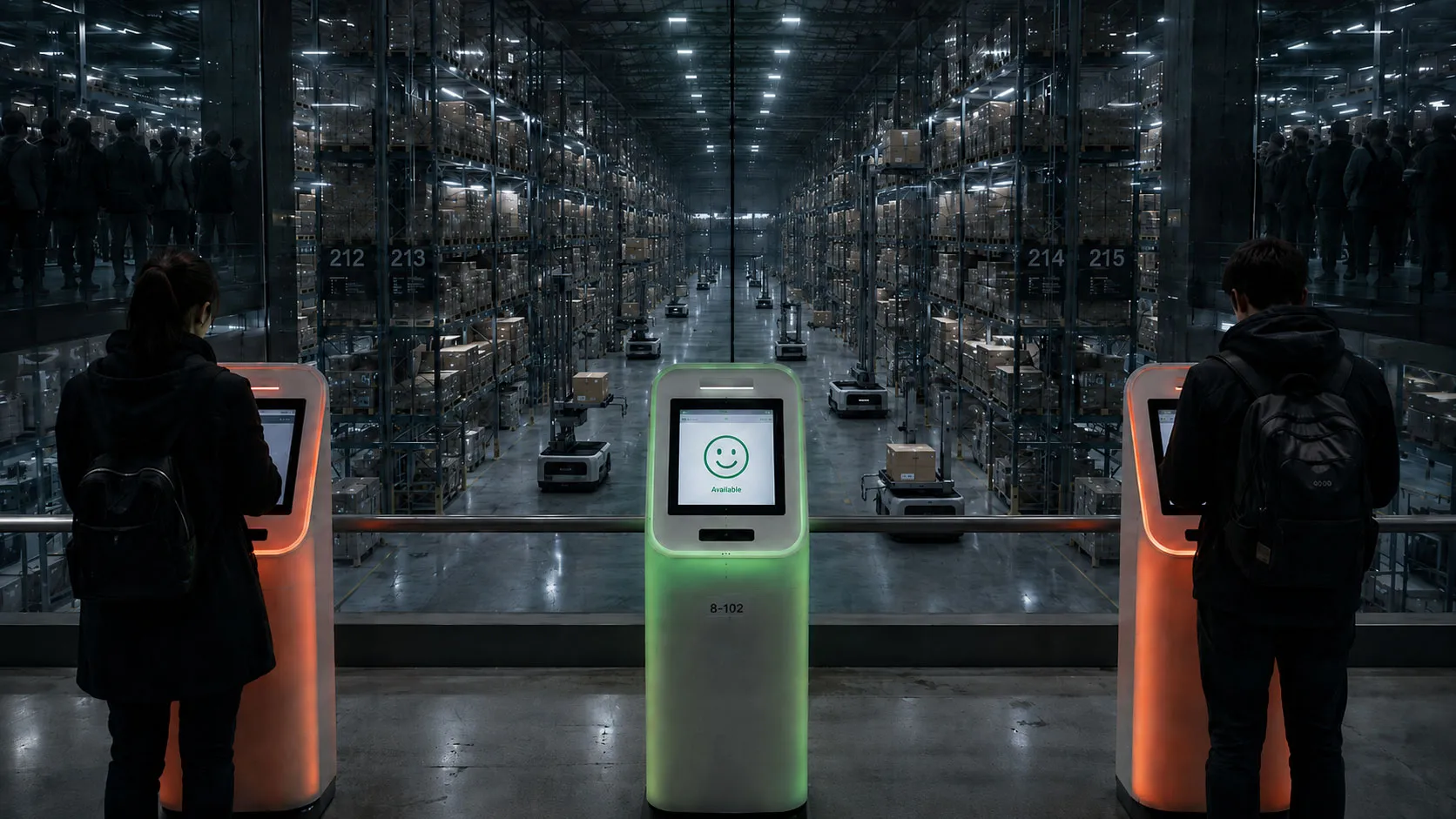
Now imagine walking into a store and being greeted by a system that knows everything.
It has the full inventory, the complete store layout, every company policy memorized. It has your face on file, your purchasing history, your customer profile. It knows what you bought last time and what you are statistically likely to want next. It is unfailingly polite, infinitely patient, and available around the clock. It will never have a bad day. It will never fumble a greeting. It will never need to glance at a colleague for help.
It is, by every measurable metric, better at the job.
And yet something is lost, and you feel it immediately, even if you cannot name it.
Nothing is at stake.
Nobody is becoming anyone through this exchange. Your patience produces nothing, not for you, not for the machine, not for anyone watching. You perform the social motion of being helped while being denied the thing that makes the interaction meaningful. The transaction completes. The outcome is equivalent or better. And something that used to be human is simply no longer there.
We register this before we can explain it. Somewhere older than the intellect, somewhere that understands the difference between an exchange that connects you to the human chain and one that merely occupies the space where that connection used to be.
At small scale this is convenience. At the scale it is happening now, across every product surface simultaneously, it’s something else.
V. Empty Calories
If you want proof that humans crave connection above almost anything else, look at what we actually got addicted to.
It wasn’t an app that teaches you an endless stream of useful facts. It wasn’t the platform that teaches you history, science, or literature. The platforms that captured billions of hours of human attention were Instagram and TikTok. Platforms whose core product is watching other humans and simulating connection.
Listening to people talk. Watching them live their lives. Feeling, for a moment, involved, connected, part of something, because our ancient brains can’t quite tell the difference in the moment between watching someone and being with them, between listening and being listened to.
People aren’t addicted to information, they’re addicted to the sensation of social connection, even when it’s hollow.
The doom scroll is the empty calories of belonging. A momentary hit of pseudo-presence. Another face, voice, and life, close enough for the brain to register proximity and mistake it for participation.
It’s vapid, and like the sales of weapons-grade corn syrup, highly profitable. It worked because it exploited the deepest and oldest need we have.
AI is the next refinement of this. It mimics enough of the shape and texture of being heard and responded to that some part of the brain lights up the way it is supposed to. It gives the sensation of response without reciprocity, attention without presence, conversation without mutual formation. There’s no one on the other end of the conversation. There’s no shared risk. No one is becoming anyone in the exchange.
The hit comes and dissipates and leaves you exactly where you were, except slightly more habituated to the substitute and slightly less connected to the real thing, less fit for social connection, just morbidly isolated.
We already know this pattern because we’ve been living it for fifteen years. Social media proved that humans will consume limitless quantities of fake connection, making opportunities for real connection even more scarce. AI doesn’t solve that scarcity, instead it offers a convincing yet hollow substitute.
And the more convincing the substitute becomes, the less anyone notices what it replaced.
VI. A World Where Nobody Needs Anyone
We had a chance to notice this with social media and we didn’t take it.
We had a decade and a half to ask what it meant that the most addictive technology in history was one that exploited the need for human connection without providing much of it. Instead we measured engagement and the rise of stock portfolios.
Now the same pattern is accelerating into something more immersive, more convincing, and potentially more all encompassing. Once again, nobody with the power to slow it down has much incentive to ask the obvious question.
Dario Amodei writes about machines of loving grace and a future where AI is the great equalizer, where abundance flows and suffering recedes. Sam Altman talks about universal basic income, a world where the machines do the work and people are free to do whatever they want. The keynotes paint a beautiful picture of a perfectly mediated society, clean and frictionless, where autonomous systems handle the complexity and humans are liberated into leisure, creativity, and self-actualization.
But if you sit with it honestly, it’s also a vision of a world where nobody needs anyone else for anything.
Today the AI features are annoying. You can dismiss the chatbot, ignore the autocomplete, scroll past the generated summary. You can opt out, mostly, if you are willing to tolerate the friction of refusal.
But the vision these companies are selling isn’t a world of optional features. It’s a world where AI performs the tasks, holds the jobs, and mediates all interactions (overseen of course by machines of loving grace and their masters).
If that vision is realized, even partially, opting out stops being a choice. AI becomes the car insurance agent you file your claim with. The grocery store checkout. The food delivery robot. The store clerk. The municipal office you apply for permits through. The bank. The intake form. AI will be first line of support and the last line of appeal.
It will cease to be a feature you can toggle off, and instead becomes the infrastructure of daily life.
Yes, jobs have always changed. Industries have always been disrupted and rebuilt. That’s an old problem being experienced at new scale and speed, and it is painful, but it’s not new.
What is new is the prospect of a world where every point of contact between a person and the systems they depend on is intermediated by something that has no capacity for sympathy, empathy, or to recognize that the person on the other side of the interaction needs just that one little bend towards exception that the rules couldn’t account for, just this once, because that is what humans do for each other when the situation calls for it.
Sympathy and empathy should not be reduced to a prompt on top of model behavior.
A society where every task, every job, every intermediary is a machine, full of loving grace or otherwise, is not a utopia, it’s a nightmare. It‘s immoral. And it’s fundamentally inhuman.
VII. Ordinary Lives
We’re constantly presented now, at least implicitly if not explicitly, with the idea that unless you’re highly visible to others and followed, your life doesn’t have value. That visibility is meaning. That going viral is the only signal available in the void, the only proof that you exist and that your existence matters. This makes a certain kind of monkey-brained tribal social sense, at least for why this idea is so deeply felt by so many. Prestige and position are worth. And where this was once mostly derived from your local surroundings, decorated with stories of rare celebrity, now it’s a dream and expectation available to every individual, set within and against the masses of the whole world.
Worse than the pressure to be seen is what it implies about everyone else: it devalues the ordinary human life, the one lived without an audience, and treats it as something lesser.
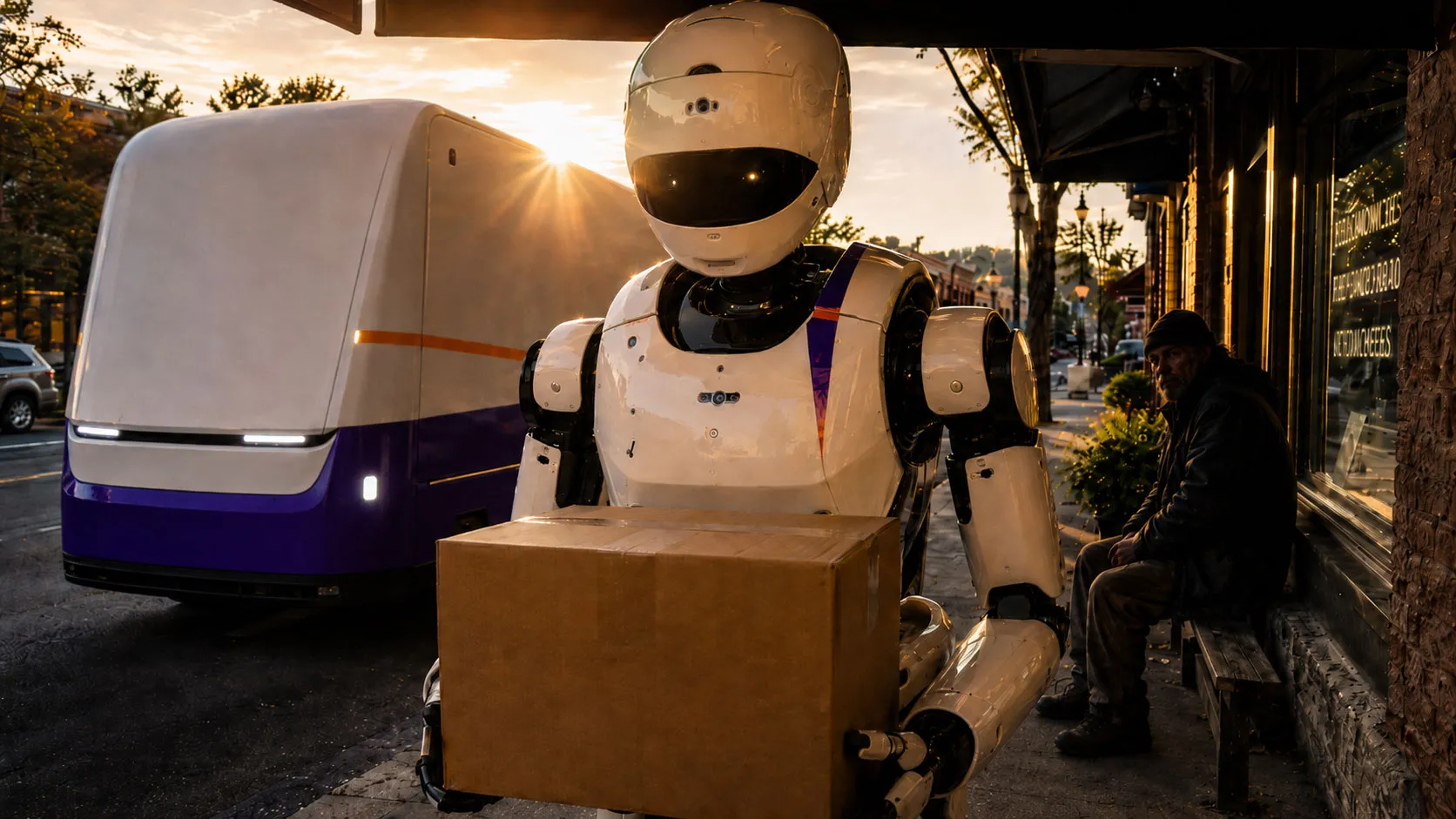
There is a sentiment attributed to Silicon Valley that has often been repeated: nobody wants that job anyway. Yes, lots of jobs are hard. Lots of jobs are boring. Lots of jobs aren’t glamorous. Many should be made better and safer and more fairly compensated, and certainly kept within the realm of cost of living. But the value of the people doing them is absolute.
The quiet dignity of work done well, of showing up and being competent and being part of something that functions because you’re there, is not a consolation prize, it’s the thing itself.
People watch The Office and Parks and Rec religiously, even still years later. Those shows don’t depict fame, they depict the ordinary. The power of those shows, the reason people return to them over and over, is that they portray the simple force of human connection in unremarkable settings. A paper company in Scranton. A parks department in a small Indiana town.
They’re celebrations of lives lived through and with others. Of people who matter to one another in ways that have nothing to do with scale, visibility, or disruption. The culture building the future often struggles to account for the ordinary, radical value of that.
And yet that’s the thing at stake. Not only employment or productivity, or whether a chatbot gives the right answer, or that a model writes clean code. The question is whether ordinary human usefulness still matters in a world increasingly designed to route around it.
That’s the thread connecting everything in this essay. The document that lost its purpose, the chatbot that replaced the teenager, the social media feed that substitutes for belonging, the feature spray that colonized every product surface: these are not separate complaints. They’re the same complaint at different scales.
They’re all symptoms of a world being built on the assumption that the friction between people is a problem, that dependency is inefficiency, and that the ideal state is one where every need is met without requiring another human to meet it.
I know this because I can feel it in my own work.
My most productive use of AI is as a way to talk with myself. I put out ideas to see them reflected back to me, to see how they look and hear how they sounds. I use it to interrogate my thinking, to find the shape of an idea by bouncing it off something that reflects it back clearly enough that I can see the parts I like and where it holds up and where it falls apart.
AI is genuinely useful. It has given me a new tool which I think I’ve figured out how to use to make me more productive at what I’m good at. However, it’s also, at its core, isolating.
The perfectly productive environment, I am learning, is the perfectly empty one. Clean, frictionless, optimized, and utterly solitary. Every inefficiency removed, including the ones that used to be called colleagues, and mentoring, and debating and conflict and resolutions and growth. It’s a machine of social alienation.
That feeling is not new.
VIII. Durkheim’s Machine
AI is often described as an unprecedented and novel social problem. However, shadows of this crisis can be seen in the nineteenth century. The machines were different but the wound is recognizable.
Émile Durkheim was writing in the 1890s, at the peak of industrialization in Europe. Within a generation, people who had lived their entire lives in agricultural villages, embedded in communities of mutual dependence and recognition, were moving into industrial cities at an unprecedented speed and scale.
As the material conditions of life changed, something was going wrong that couldn’t be explained by material conditions alone. People who were fed and housed and employed were experiencing a kind of social unmooring that nobody had language for yet. The old structures that made their existence legible had been removed, and nothing sufficient had been built in their place.
Durkheim called it anomie.
Not loneliness exactly, or lawlessness. It was a collapse of the norms, bonds, and shared meanings that make individual action feel connected to something larger than the self. Not the absence of rules, but the absence of the human framework that tells you your contribution matters, that you are seen, that your effort connects to a chain of consequence.
The village had embedded you in a web of mutual dependence. The city placed you in proximity to thousands of strangers and gave you nothing meaningful to do with that proximity. You could be surrounded by people and still be unseen, unneeded, your work disconnected from any human chain of recognition.
What strikes me is how closely this resembles what happened when we moved online. Social media was described as connecting the world, but in many ways it repeated the same pattern. We left local communities, churches, clubs, neighbourhoods, and workplaces as primary sources of identity and entered vast and anonymous digital city-scapes populated by millions. We gained access to everyone and lost connection to anyone. We became surrounded by people while becoming increasingly detached from the relationships that made us legible to one another. Where some did find connection it was all the more desperate, insular, and intense. Most only found a fleeting sense of connection, bumped and re-upped daily to avoid the reality of the situation.
Where Durkheim gave the wound a name, Tolstoy showed us what had been cut away.
Twenty years earlier, Tolstoy was writing Anna Karenina in the middle of Russia’s own version of the same crisis. The emancipation of the serfs had disrupted centuries of agrarian social structure. Industrialization was arriving from the west. The old bonds of mutual dependence between landowners and peasants were dissolving, and nobody knew what would replace them.
The liberals had their systems. The socialists had theirs. Everyone had an abstract framework for how society should be reorganized. Levin, the character through whom Tolstoy thinks about this most directly, distrusted all of them.
In a pivotal scene, Levin goes out and mows hay alongside the peasants working his farm. He does the same physical labour they do, matching their rhythm, feeling his body become part of a shared effort larger than himself. Something happens to him there that he cannot fully articulate. The meaning doesn’t come from an idea about labour. It comes from the labour itself. From the experience of work becoming real because it is shared, because his effort is visible and necessary and part of a human chain. This was precisely the thing the industrial city was dissolving, and Tolstoy captured it not as a political argument but as a felt experience that resists abstraction.

Levin’s suspicion of the reformers is the suspicion this essay is articulating about the techno-industrialists. We shouldn’t trust people who treat the question of how humans should live and work together as an engineering problem, where people are the messy problem to be abstracted or automated away.
Levin’s answer, arrived at slowly and painfully across the novel, is that meaning comes from being present to other people in the context of shared effort. Not from the system. Not from the theory. From the doing, together.
It feels strange that people working with the most advanced technology ever created could be experiencing a crisis a Russian novelist and a French sociologist described almost hundred and fifty years ago, until you realize that while the technology changes the human need does not.
The social turmoil unleashed by industrialization didn’t resolve neatly. It fed political, economic, and spiritual convulsions that shaped the next century. Not because those outcomes were inevitable, and not because they followed mechanically from the technology, but because when you devalue and dehumanize people at scale, when you strip away the structures that give ordinary life meaning and offer nothing in their place, the response is unpredictable and often desperate, powered by an irrepressible human need to be recognized and valued.
The industrial city was the first great engine of anomie at scale. It pulled people out of the social substrate that made their effort meaningful and placed them inside systems too large to be personal and too impersonal to return what the village had provided.
We built the second engine ourselves. We called it a platform. We measured its success in “engagement”. Now, the people building the third engine, the one made of language models and autonomous agents, talk about mass or total worker displacement in a way that clearly demonstrates they don’t understand what happened the last two times, that they don’t understand people, community, or society.
IX. The Commons and the Builders
The backlash against AI isn’t a skill issue, or technophobia, or nostalgia. It isn’t that “ordinary” people are failing to adapt to an inevitable future. Framing it that way, which is the default move of every techno-industry caught in the cultural backlash, misreads the signal completely. It‘s people registering, feeling and suspecting if perhaps unable to articulate, that something necessary is being removed. It’s the same signal Durkheim was reading in industrializing Europe, the same loss Tolstoy rendered through Levin in the field.
Every place where AI answers, assists, smooths, summarizes, or completes is a place where the mutual-stake transaction no longer occur. An exchange happens, and you might argue the outcome may be equivalent, but the part that connected the action to human consequence is absent.
At small scale, this is convenience. At the scale it is happening now, across every product surface and job simultaneously, it’s the systematic replacement of the social substrate with something that resembles it closely enough to occupy its space without performing its function.
What’s often called the American dream was never uniquely American. It is the ordinary human desire for a home, a family, useful work, familiar faces, shared meals, elders cared for, children better off, and a community that knows your name. It was always the dream of belonging to the tribe and feeling a sense of earned and given value. At its best it was never really about accumulation. It was about participation: the sense that your effort connected you to something real, that you were seen by the people around you, that you belonged to something that would outlast you.
Unifying dreams of innovation, exploration, and belonging used to belong to nations and include all citizens (at least in the ideal). As that has shifted to corporations, those dreams increasingly belong tenuously to their employees, to the exclusion of others. The tribe became the company.

The offer being made now to the rest of society is optimized isolation with better content. People know these aren’t the same thing even when they can’t say why.
The technology industry struggles to understand this because its culture and incentives reward a very particular worldview. Friction is treated as failure, dependency is treated as inefficiency, and social complexity is treated as a design problem to be optimized away.
There is a strange contradiction at the centre of all this. The same companies whose valuations increasingly depend on reducing the need for human labor, place enormous value on human affiliation internally. People compete fiercely to join OpenAI, Anthropic, Google Brain, and the rest. Entire media ecosystems have emerged around who works there, who left, who joined, who is on which team. Investors talk about talent density. Founders talk about culture. Employees describe the experience in almost tribal terms. Everyone wants to belong and belonging is one of the greatest perks.
Everyone involved seems to understand, at least implicitly, that being part of a group of talented people working toward a shared goal is one of the most meaningful experiences available to human beings. Yet many of the same organizations are building toward a future where fewer people get to have that experience through work.
I don’t think this is hypocrisy so much as a blind spot. They understand the value of belonging when it applies to themselves. They struggle to see that the thing they cherish inside their organizations may be exactly the thing they are helping to remove from society around them.
Connection, in this worldview, becomes something to engineer rather than something to feel. Human need becomes a use case. Human presence becomes latency. People are difficult, unpredictable, emotional, reciprocal, and morally inconvenient, and all of that becomes a problem to solve, an edge case to account for.
But connection was never a problem to be engineered, says the commons, increasingly at volume, in a register that sounds of rage but is underneath it actually something closer to grief.
X. What This Means
The backlash won’t be resolve by making the AI better.
A more capable chatbot isn’t the point. A more accurate document generating machine isn’t the point. A more convincing facsimile of human presence deepens the problem rather than addresses it. If the objection is fundamentally about the absence of humanity then more capability isn’t the answer.
XI. The Practitioner’s Position
Over the past two years, I have done some of the most prolific, productive, and valuable work of my thirty-year career in very large part thanks to the tools and capabilities provided by AI.
And yet.

The dream is still to work with a small group of like-minded people. To have human interactions even on the days when I don’t think I want them. To feel part of a community where that community is not the semblance or miasmic impersonation of one.
I have no doubt that AI will be part of whatever I build next. I find genuine value in it. But I am also keenly aware that even where it could replace junior people on a team, even where I could design a system to do that sufficiently well, I do not believe that is the best thing for me or for society.
A certain degree of friction in interactions is what makes us better.
The social is inherently entangled with productivity, and if you try to separate the two, you are not describing people. You are describing machines, and people as components of machinery.
The dehumanization of workers has been the central problem since the dawn of the industrial age. It did not begin with AI and it will not end with AI, but AI is the latest and most powerful accelerant.
AI, as a catch-all for the new programs we are learning to use and integrate into our work and lives, will find its place the way every tool eventually does. The way the newfangled to-do list did. The way the encyclopedia on CD-ROM did. The way the digital calendar did. It will be part of how we work. It should not become the replacement for why we work.
The tools are real. The value is real. The million-line codebase that no team had been able to map and then was mapped, that happened. None of it needs to be given back.
None of that means we should aim to automate away the friction between people. A little of that friction is what makes life worth living.
I am building AI tools for the same reason I am writing this essay: because I have ideas I want to share with other people. I work on them, sometimes desperately, to figure out how to communicate them clearly, not so they can be broadcast or observed from a distance, but so that they can become part of a conversation.
The tools I build are in service of that. The words I write are in service of that. The long hours alone with a language model helping me find the shape of what I am trying to say are in service of that. But the destination is always the same: other people.
That is what the industry has not yet understood, and what the backlash is trying to tell them.
The question was never how to make the model better, distribute the feature more widely, or communicate the value more persuasively to people who aren’t listening.
The question is whether we are building tools that help people connect, or systems that make connection unnecessary. If it’s the second, then it doesn’t matter how good the technology gets. We will have automated the surfaces of human life and mistaken the absence of people for progress.